

Welcome to the Collector’s Club.
Thank you for supporting the studio. Your funds directly fund art and marketing materials that allow the art to be made and the studio to grow.
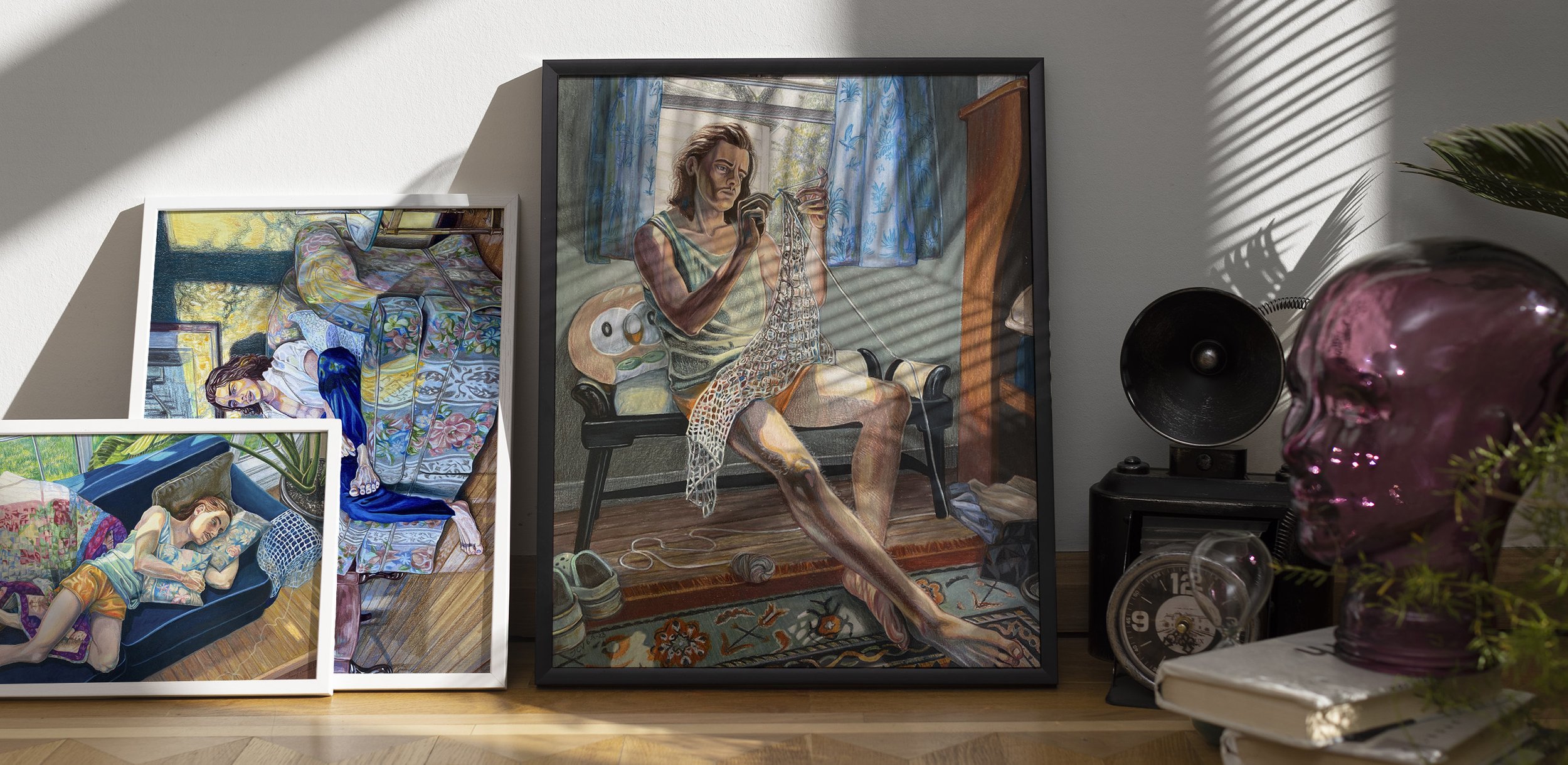
Ready to be buried in art?
This Month’s Art Print
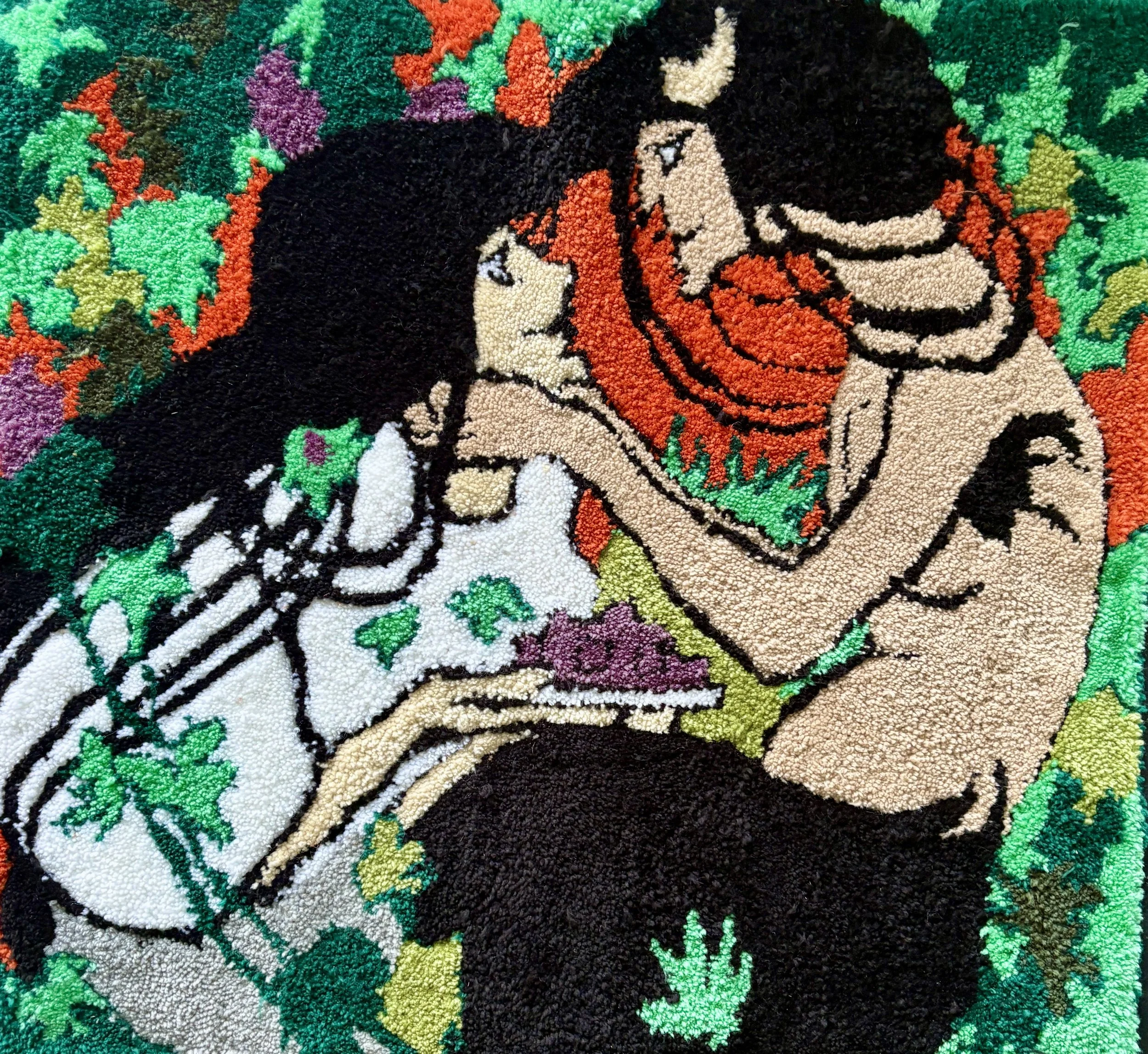
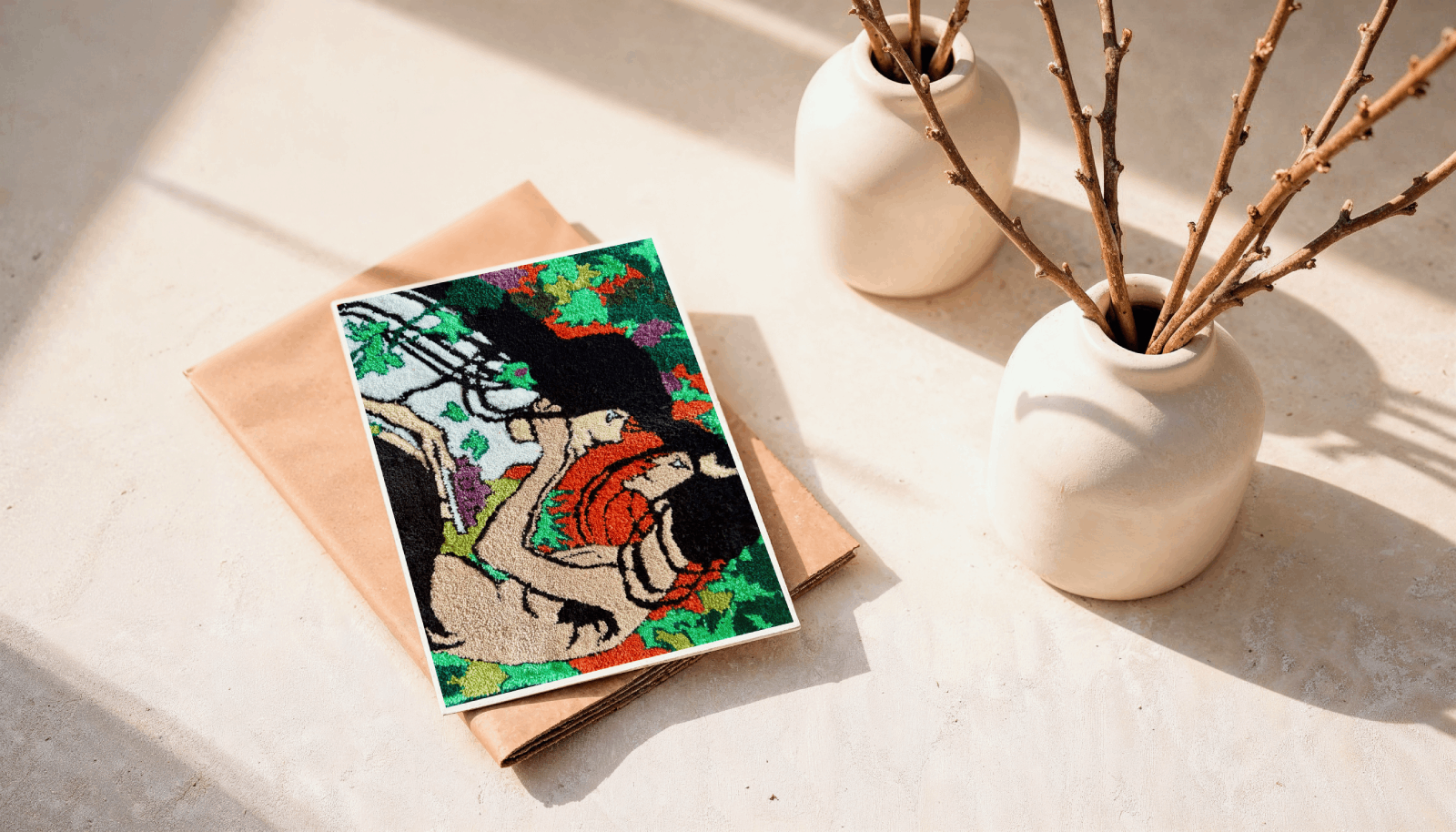
Satyr & Nymph
This month's piece is a love story — specifically, the one unfolding between a satyr and a nymph at the center of this textile artwork, created using tufted yarn. It's inspired by the 1894 literary poster When Hearts Are Trumps, illustrated by Will H. Bradley.
When I first came across the original image, I assumed Bradley was nodding to the myth of Ampelus and Dionysus: a beautiful satyr whom the god fell deeply in love with, and who, after being killed by a bull, was transformed into the world's first grapevine. A tender, tragic story, and rich visual territory that fits naturally into this body of work.
But as I dug into the history of the image, a different story emerged, and honestly a more charming one. This poster was Bradley's very first commissioned illustration, made for a small publishing house founded by two Harvard students who were still setting up their letterhead. Two ambitious kids with a printing press and a poet to promote. Bradley responded by drawing two young lovers, classical and romantic, reaching toward each other across the page.
I'll admit I see myself in that origin story a little. But what strikes me just as much is the context it was made in. The literary poster was still a developing art form at the time, only just finding its footing in the United States. It wasn't considered high art. It was commercial, it was quick, and its flat graphic style was often dismissed for exactly those reasons.
And yet Bradley kept reaching for classical mythology, for timeless iconography, for images with weight and intention. I can't help but read that as a quiet act of defiance: a belief that the work was worth taking seriously, even when the medium wasn't.
This month's print asks us to question the value of art, which is a question constantly relevant to me. We've all heard the complaints about minimal modern art: a single color flooding a canvas, a few lazy brushstrokes on white. "My three year old could do that." But art is more than a well crafted image. It's a story people buy into, and a layer of compelling history that gives it its allure.
The Art Archive of 2026.
-
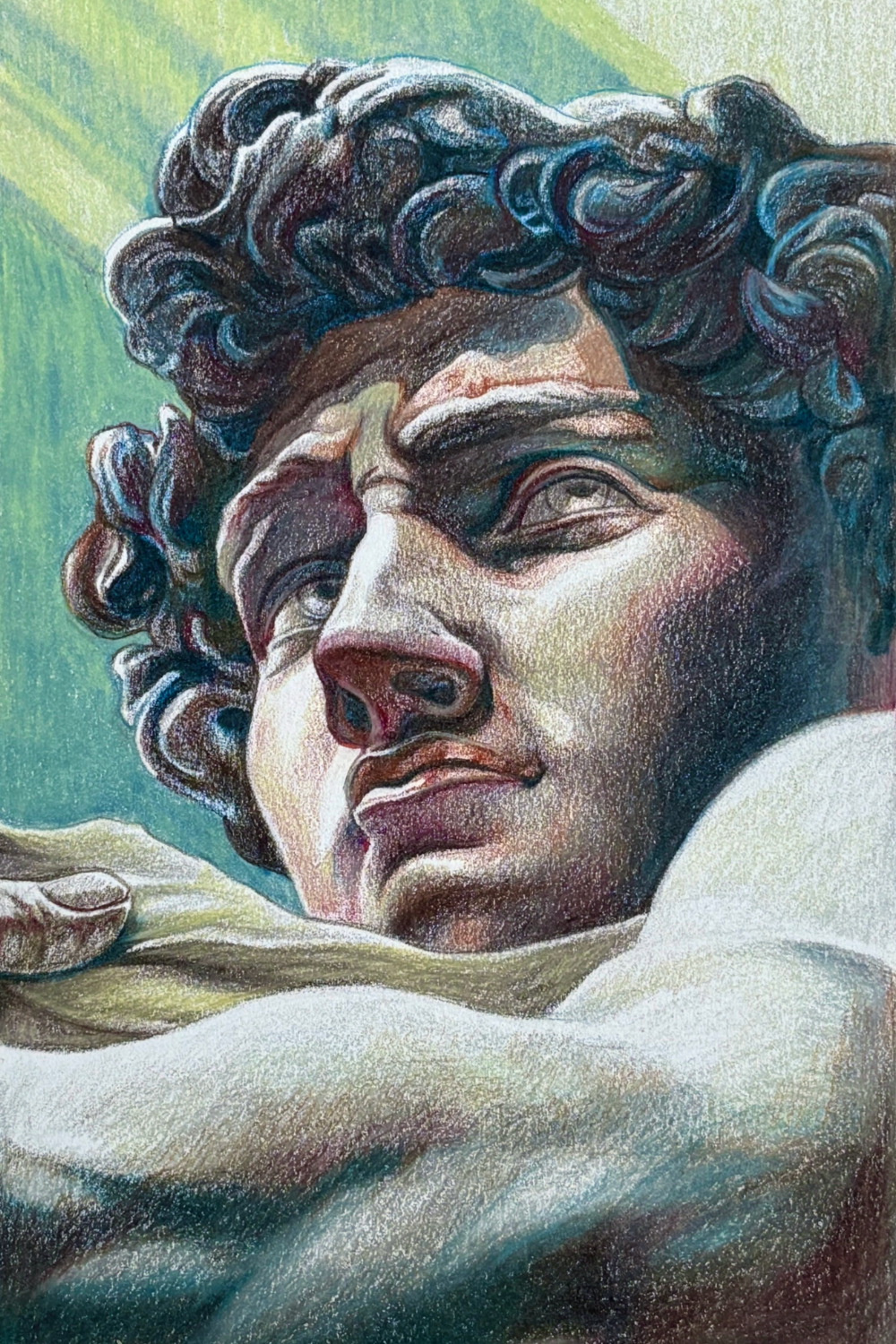
Drawn from Michaelangelo’s Statue of David (located in Florence, Italy), this homage to the renaissance masterpiece depicts the pensive underdog right before his fated battle with the giant, Goliath. The color palette is largely made of cool blues and green with accents of deep red which highlight David’s focus and intensity.
The original statue was carved from solid marble to showcase the idea human form, perfect in both musculature and proportion. It was a created in a period of ideological re-awakening, during which blind faith in the divine was becoming replaced with more humanistic and individualistic thought.
While the statue’s physique highlights beauty, Michaelangelo’s choice to depict David specifically implies a return to classical (as in Ancient Greece) beliefs of intellect and critical thinking; for it it was David’s creativity and wit that granted him victory in his battle.
-
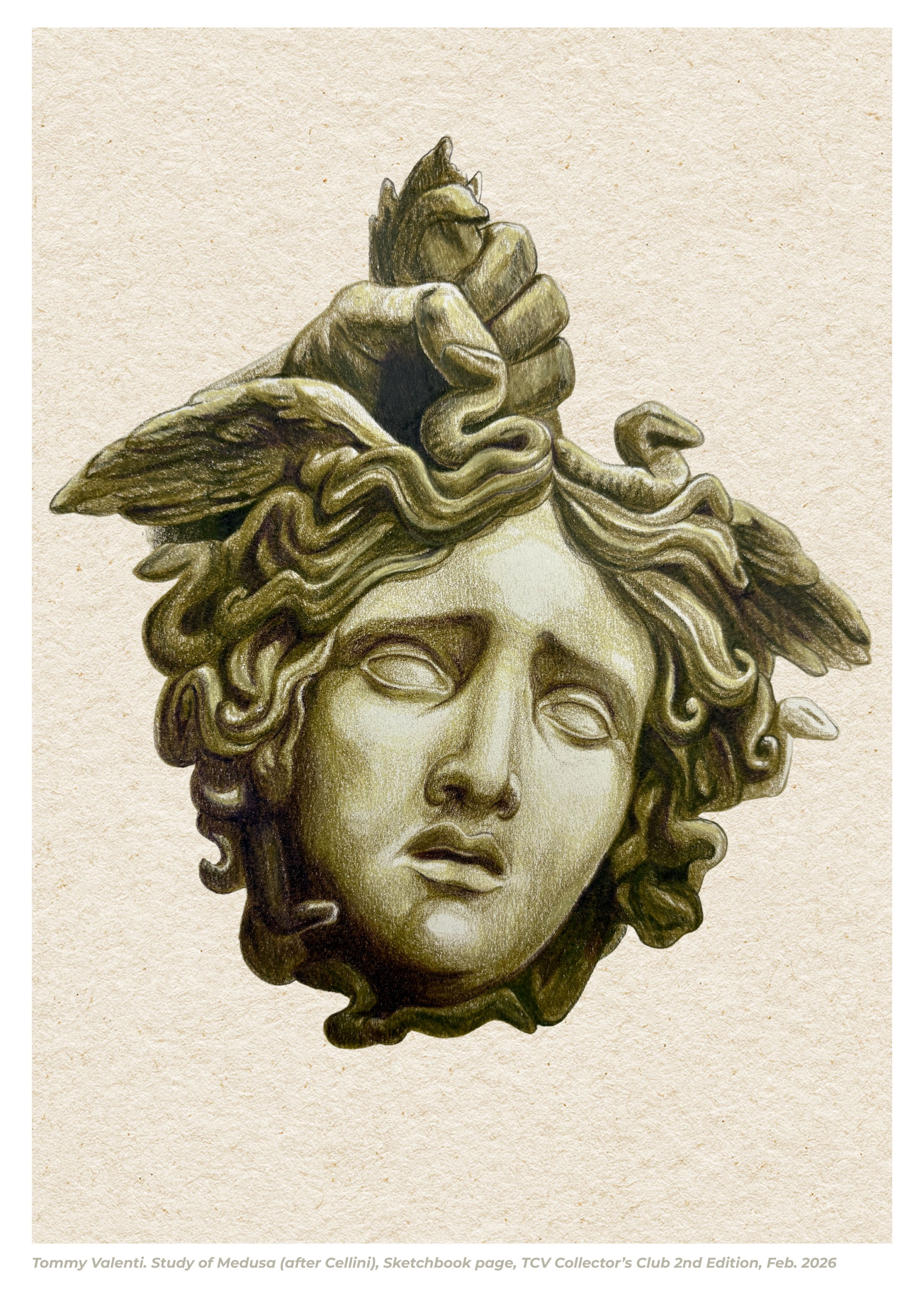
Drawn from Perseus Holding the Head of Medusa (most famously sculpted by Benvenuto Cellini and housed in Florence, Italy), this study captures Medusa not in life, but in the charged aftermath of her defeat. Her severed head hovers between horror and tragic stillness, presenting the viewer with both her power and her punishment.
Historically, Medusa was synonymous with monstrosity: a woman whose gaze turned men to stone, her beauty transformed into terror. In classical mythology, the once-priestess was cursed by Athena after being seduced by Poseidon, an act that broke her vow of chastity.
In this clean-cut version of events, Medusa’s fate functions as a cautionary tale of a woman’s daring deviance, her violent end a glorification of retaliation against women’s autonomy. Renaissance-era symbolism leaned into this narrative, using Medusa as a dramatic emblem of conquered chaos and masculine triumph.
Yet in modern revisits of the tale, a more complicated and compelling story surfaces. Medusa was not seduced by Poseidon, but forcibly taken, and—unable to retaliate against the god—Athena instead punished the victim. In this telling, Medusa was not born a monster, but was made one. Contemporary interpretations reclaim her image as a symbol of justified rage and female power, her gaze now a symbol of autonomy and her death a tragedy.
This month’s print invites you to look twice. Gaze past the myths and villains you were taught to fear, and instead, distinguish if there is a more ignored evil.
-
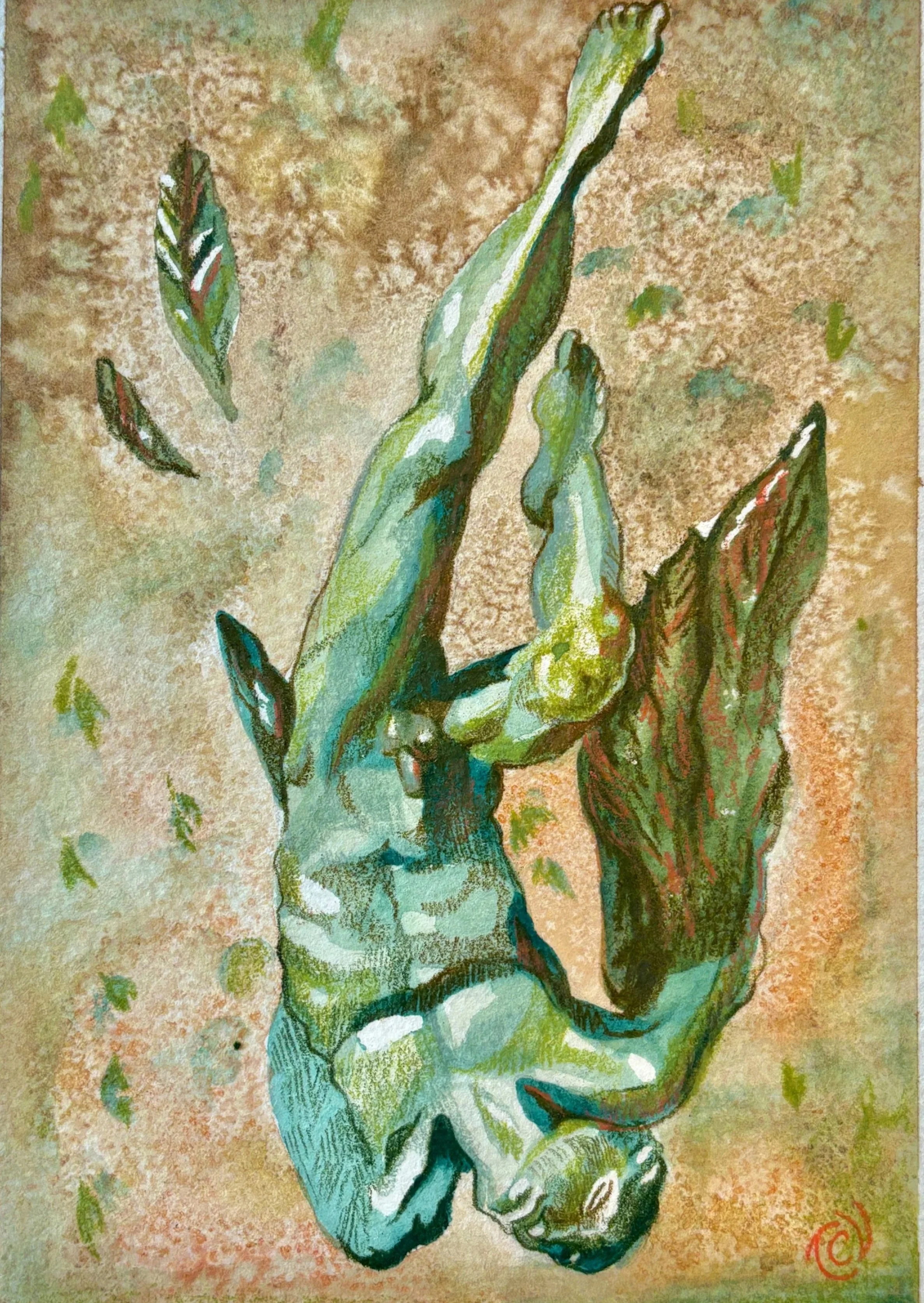
Inspired by Lucianne Lassalle’s bronze sculpture, Icarus with Burning Wings, this study captures Icarus not in flight, but in the middle of his collapse. Unlike my usual style of tight, technical portraits, this piece leans into a more fluid, "melting" look. Depicted upside-down and coming apart, his form shows the physical toll of reaching for something forbidden. The color palette of oxidized greens and hot oranges pays homage to the original bronze medium and the scorching heat of the sun.
The traditional version of Icarus is a simple lesson on hubris: the boy who was too arrogant to listen to his father’s warnings and paid the ultimate price. In this classic view, his fall is a necessary "reality check," a reminder to stay in your lane and avoid overreaching. It’s a story used to celebrate caution over curiosity.
However, when we look closer at Lassalle’s interpretation, a more sympathetic story emerges. To fly at all required an incredible amount of bravery and a refusal to stay trapped in the Labyrinth. From this perspective, Icarus isn't just a reckless kid; he’s a symbol of the human desire to transcend our limits, even when we know the risks. His melting wings aren’t just a sign of failure—they’re the literal cost of a moment of total freedom.
This month’s print asks you to look at the descent differently. Instead of seeing a foolish mistake, can we see the courage it took to touch the sky? Is it better to stay safe on the ground, or to risk everything for one moment of brilliance?
-
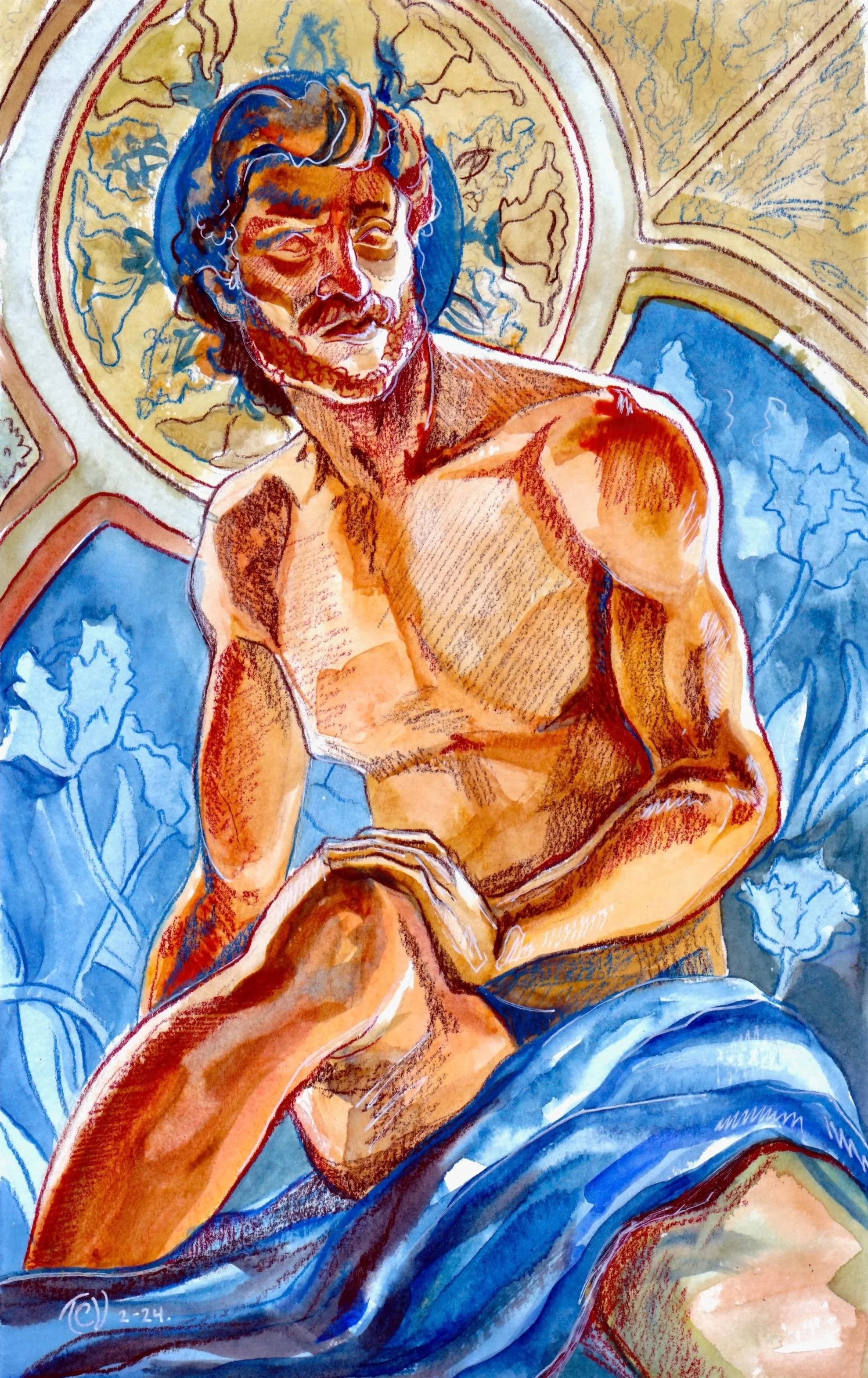
Drawn from historical depictions of Archimedes of Syracuse, this study doesn't attempt to capture a likeness so much as a feeling: the particular stillness of a person absorbed in thought, unreachable. The color palette reflects the warmth of the drawing itself — bronzy oranges and deep, burnished golds that pop against the page, less the cool of the Mediterranean and more the heat of a mind perpetually on fire.
Most of us know Archimedes the same way we know a lot of ancient geniuses: through a single, convenient story. A man steps into a bath, notices the water rise, and runs naked through the streets screaming "Eureka!" It's a good story. Memorable, undignified, human. And it has almost entirely replaced the man himself.
What actually occupied Archimedes — the decades of letters exchanged with fellow mathematicians, the treatises on spirals and floating bodies, the geometric proofs so precise they wouldn't be matched for nearly two millennia — doesn't make for as clean a legend. Neither does the way he died: killed by a Roman soldier during the siege of Syracuse, reportedly so absorbed in a diagram scratched into the dirt that he didn't register the city falling around him. Do not disturb my circles, he is said to have told the soldier. Whether he said it or not, we chose to remember it. That choice says something.
I find the legacies that stretch across centuries to be genuinely fascinating. Did Archimedes literally run through the streets shouting Eureka? Probably not — yet there's a charisma to that caricature that has flattened the full depth of his human story. Over time, Archimedes becomes a bathtub. Newton becomes an apple. But I find myself far more interested in who they actually were.
What does it take to be a person so devoted to the abstract truths of mathematics that a falling city barely registers? Did that same intensity make him a loving father, a present friend — or is that the tradeoff? These are unanswerable questions, and maybe that's the point. They turn my own mind toward the values I'd like to be remembered for, and quietly ask whether my most recent decisions have kept me on that path.
-
This month's piece is a love story — specifically, the one unfolding between a satyr and a nymph at the center of this textile artwork, created using tufted yarn. It's inspired by the 1894 literary poster When Hearts Are Trumps, illustrated by Will H. Bradley.
When I first came across the original image, I assumed Bradley was nodding to the myth of Ampelus and Dionysus: a beautiful satyr whom the god fell deeply in love with, and who, after being killed by a bull, was transformed into the world's first grapevine. A tender, tragic story, and rich visual territory that fits naturally into this body of work.
But as I dug into the history of the image, a different story emerged, and honestly a more charming one. This poster was Bradley's very first commissioned illustration, made for a small publishing house founded by two Harvard students who were still setting up their letterhead. Two ambitious kids with a printing press and a poet to promote. Bradley responded by drawing two young lovers, classical and romantic, reaching toward each other across the page.
I'll admit I see myself in that origin story a little. But what strikes me just as much is the context it was made in. The literary poster was still a developing art form at the time, only just finding its footing in the United States. It wasn't considered high art. It was commercial, it was quick, and its flat graphic style was often dismissed for exactly those reasons.
And yet Bradley kept reaching for classical mythology, for timeless iconography, for images with weight and intention. I can't help but read that as a quiet act of defiance: a belief that the work was worth taking seriously, even when the medium wasn't.
This month's print asks us to question the value of art, which is a question constantly relevant to me. We've all heard the complaints about minimal modern art: a single color flooding a canvas, a few lazy brushstrokes on white. "My three year old could do that." But art is more than a well crafted image. It's a story people buy into, and a layer of compelling history that gives it its allure.
-
To be revealed
-
To be revealed
-
To be revealed…
-
To be revealed
-
To be revealed
-
To be revealed…
-
To be revealed
Art Club Perks
-
While you are enrolled in Art Club, you have access to the largest discount rates I offer. You’ll find these codes in your emails throughout the year!
-
By joining art club, you are automatically a TCV Collector! Should you ever want to purchase an original artwork from me, you’ll get a special discount that is only offered to collectors.
-
The Art Club will always be the first to see new art that is being created in the studio. It’s the most exclusive way to peak into the studio production and updates.
-
2-3 artworks produced each year will ONLY be available to this small group of collectors.
By joining the Collector's Club, you will receive one collectible art print per month, delivered from the studio of Tommy Carmelo Valenti right to your doorstep. Additional perks included. (Cancel anytime).